Field Notes
The Question Underneath "Will AI Take My Job?"

The question shows up twice in most organizations. It does not sound the same both times.
The public version arrives in the all-hands. Someone who is not the most worried person in the room asks it carefully. The answer is about augmentation and freeing people for higher-value work. The private version arrives later, at home. It is blunter. Is this coming for me.
Now look at the small number of people who are not asking it. Not the optimists. Not the ones who think thier function is exempt. The ones who can tell you, without preparing first, which three or four decisions in their week actually moved something. Who was on the receiving end. What would have gone differently if those decisions had been wrong.
Their calm is not a forecast about technology. They can name their contribution. A named contribution can be defended, improved, or handed off on purpose. Everyone else is being asked to defend four things priced as one.
A job priced four things as one
A job was a container. Activity: what you did all day. Capability: what you knew how to do. Authority: what you were allowed to decide. Contribution: what became better becuase you were there. One title. One salary. One review cycle. Four different things. No requirement to separate them.
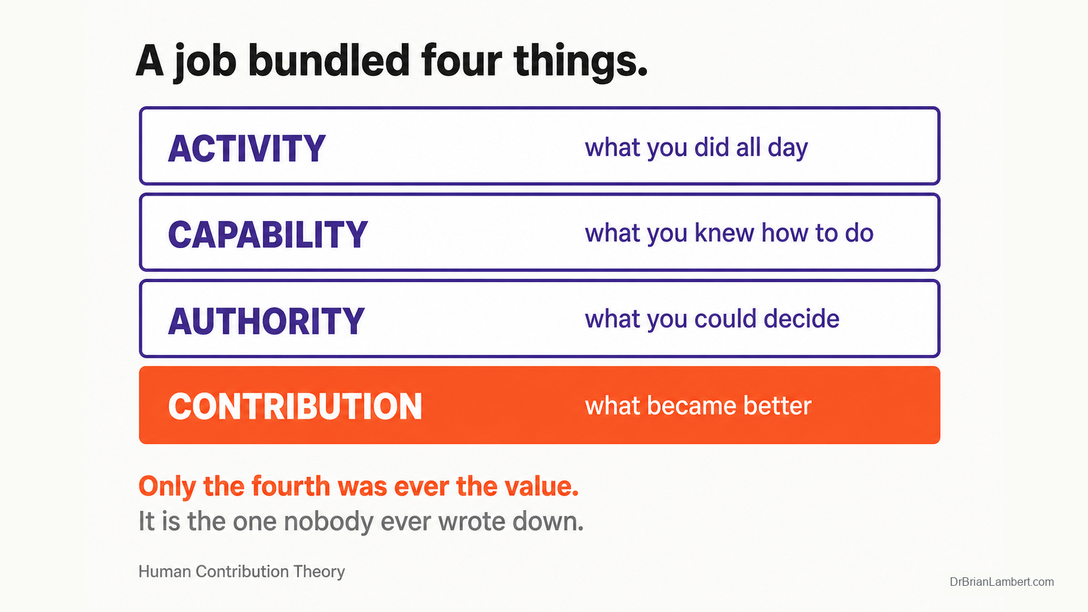
That pricing worked as long as one human carried all four. If you could do the work, you did the work, and the work you did was treated as your contribution. Nobody asked which part was which. The parts never came apart.
AI takes them apart. Once the doing can be reassigned, the question of what the doing was for becomes unavoidable.
So the honest fear is not that a machine can do what you do. It is that nobody ever told you which part of what you did was the part that mattered. Now something else is going to decide.
The more specific question is the one worth answering
Which parts of what I did were the parts anyone valued?
Most competent people cannot answer that quickly. The reason is structural. Ask anyone to list what they do and you get activity, because activity is what the calender records. Ask what became better because they were there and the answer needs three things: what the organization was trying to make true, who was on the receiving end, and what counted as good enough. Those three things were rarely written down anywhere the person could reach.
The producer does not get to declare its own contribution valuable. So the individual cannot answer this question alone. They also cannot fairly be blamed for not answering it. Half the information sits on the other side of the handoff.
The capability was there the whole time. What was missing was direction specific enough to convert it.
Capability without activation is potential. Activation without direction is activity. Contribution is activated capability directed toward an outcome.
Everything written for the agent is the brief people never got
Somebody is configuring an agent this quarter. The work is unglamorous and extremely specific. A role. Allowed sources and banned sources. Definitions for terms the company has used three different ways for years. Business rules. Workflows. Tools with permissions bounded to particular records. Examples of output that was accepted and output that was sent back. An escalation threshold. An evaluation. A log. Somebody who signs off when any of it changes.
Every item on that list was a requirement for the human doing the same work. None of them were ever stated.
The definitions got absorbed over months of meetings. The escalation threshold was learned by escalating something too late, once. Acceptable work was reverse engineered from what came back and what did not. We called that experience. We priced it. It was real. It was also unwritten and impossible to hand to anyone else.
An agent will not tolerate that arrangement. It gets the specification or it produces fluent, confident, well-formatted nonsense. That is why this material is finally being written down. The limit was never really the model. It was the organization's own context, carried in people's heads.
Organizations now describe agentic capability with precision and human contribution with aspiration. The distance between those two levels of precision is the Human Contribution Gap. Stated more plainly: we are defining the future of agents faster than we are defining the future of humans.
An agent handed the human instruction set could not start
Read the instruction set the human side actually receives. Think strategically. Exercise judgment. Be creative. Supervise the AI. Move to higher-value work.
Try to run those as a configuration. Judgment about which decisions, bounded by what, accepted by whom, evidenced how? Higher-value than what, to whom, and who decides? An agent handed that specification cannot start. A person handed it starts anyway. People compensate. They infer the intent and invent acceptance criteria. The inference is often good. It is still an inference. Nobody ever checked it.
That is why a capable person cannot say which parts of their work were valued. It was never specified. They were expected to know.
The design question is what the whole system requires
Capability Engineering is not a new name for Learning and Development. It expands the unit of capability from the individual employee to the combined human-and-AI system through which work gets done. Develop humans. Train agents. Engineer collective intelligence.
Traditional capability work starts with the person and asks what competencies the role requires. Capability Engineering adds a second question. What does this decision or workflow require from the combined human-and-agent system? Ask that on one real workflow and it produces the answer the employee has been trying to guess at for years.
What makes the answer real
A Contribution Unit is a bounded, governable requirement for value creation. It is defined by an intended outcome, relevant context, acceptance criteria, and accountable ownership. It can be fulfilled by human capability, agentic capability, or their combination.
A Contribution Unit does not exist until both its acceptance criteria and acceptance authority are defined.
When work is specified this way, a person can point at the units they hold, the criteria those units were accepted against, and the authority that accepted them. That is a defensible answer. It holds up in front of a CFO.
It also survives the arrival of agents, because the unit is allocation-neutral. Human, agent, or both is a decision made about a Contribution Unit, not a decision that destroys one. When an agent takes a unit, the person can see what moved and what remains.
Where to start
Pick one outcome your team owns this quarter. For each piece a human holds, write four lines:
- What must become true. The outcome, not the activity.
- What counts as accepted. Specific enough that two reasonable people looking at the same piece of work would land in the same place.
- Who has the authority to accept it. A name.
- Who owns the outcome when it goes badly. Also a name, and usually not the same one.
Most human roles do not have those four lines anywhere. Every agent in the same workflow has all four sitting in a configuration file.
If you are asking the question about yourself, take last week. Not the job description. The actual week. Next to each block, write who received something and what they did with it. The blocks where you cannot name a receiver are the unexamined ones. Unexamined is what gets cut first.
Find out who accepts the work you think matters. Look in the operating review, not the job description.
Ask which parts of last week had a named receiver. Ask what would count as accepted for those parts. Ask what you would trade up if an agent took one unit.
People who can answer the second question stop asking the first one. Their position is no safer than anybody else's. They just have something specific to defend, sharpen, and trade up.
The useful move is not more productivity. It is more consequence.